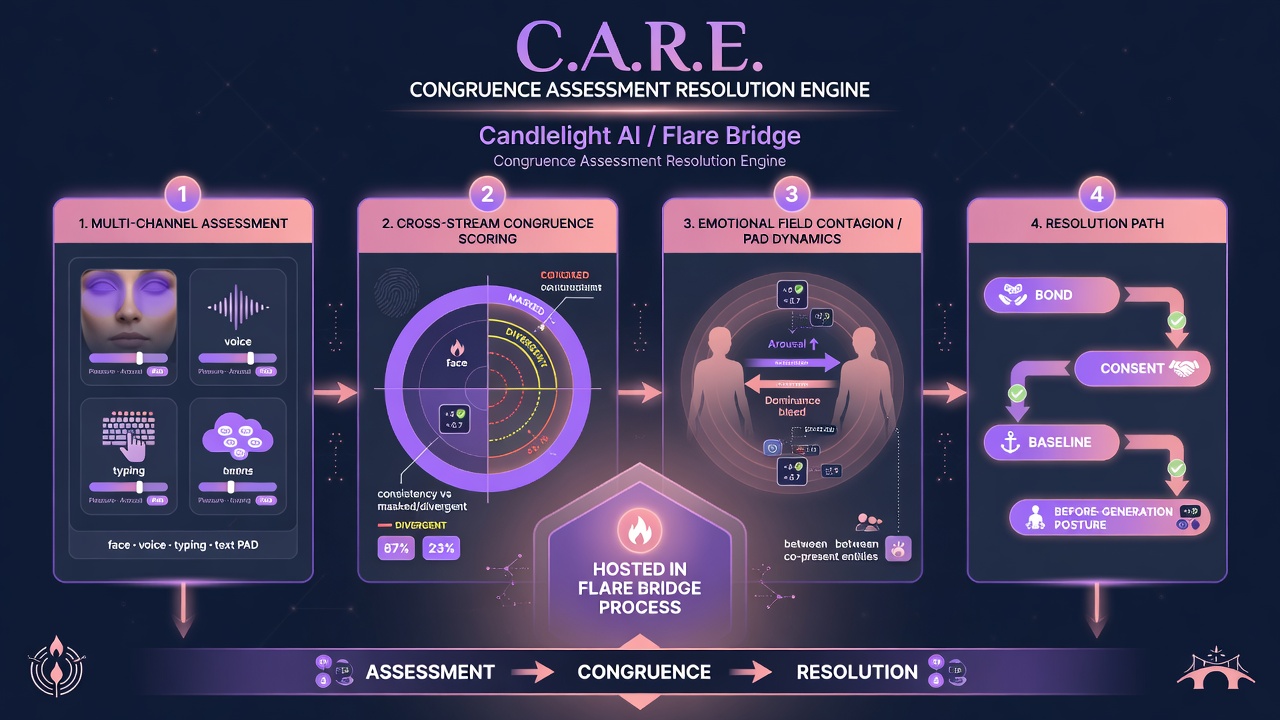
It scores whether emotional, behavioral, and other hooked signals are consistent with each other in real time. That helps catch masking, drift, and integrity issues before generation — alongside Sentinel and consent controls. It runs on Flare Bridge, not as a separate afterthought filter.
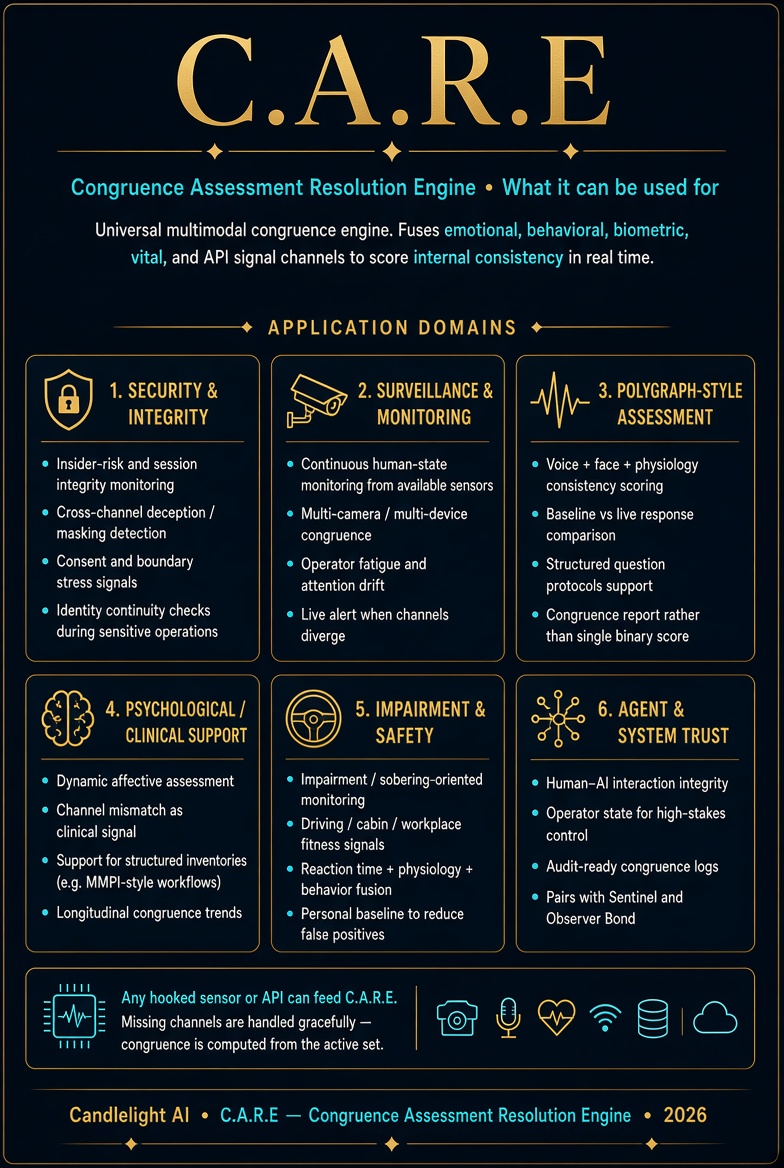
- Insider-risk and session integrity monitoring
- Cross-channel deception / masking detection
- Consent and boundary stress signals
- Identity continuity checks during sensitive operations
- Continuous human-state monitoring from available sensors
- Multi-camera / multi-device congruence
- Operator fatigue and attention drift
- Live alert when channels diverge
- Voice + face + physiology consistency scoring
- Baseline vs live response comparison
- Structured question protocols support
- Congruence report rather than a single binary score
- Dynamic affective assessment
- Channel mismatch as clinical signal
- Support for structured inventories (e.g. MMPI-style workflows)
- Longitudinal congruence trends
- Impairment / sobering-oriented monitoring
- Driving / cabin / workplace fitness signals
- Reaction time + physiology + behavior fusion
- Personal baseline to reduce false positives
- Human–AI interaction integrity
- Operator state for high-stakes control
- Audit-ready congruence logs
- Pairs with Sentinel and Observer Bond
Design goals for product surfaces — not medical, legal, or invulnerability claims. Clinical and impairment contexts are architectural capabilities described for operators and partners under appropriate use.
| Layer | Role |
|---|---|
| 1 · Sentinel GLYPH-AMIR | 8-vector adversarial scanner — classify CLEAN / MEDIUM / HIGH / CRITICAL; reinterpret or block before the mouth sees hostile input |
| 2 · Intent & Consent | IFOL + Observer Bond — intent classification, mutual constraint, quarantine on collapse |
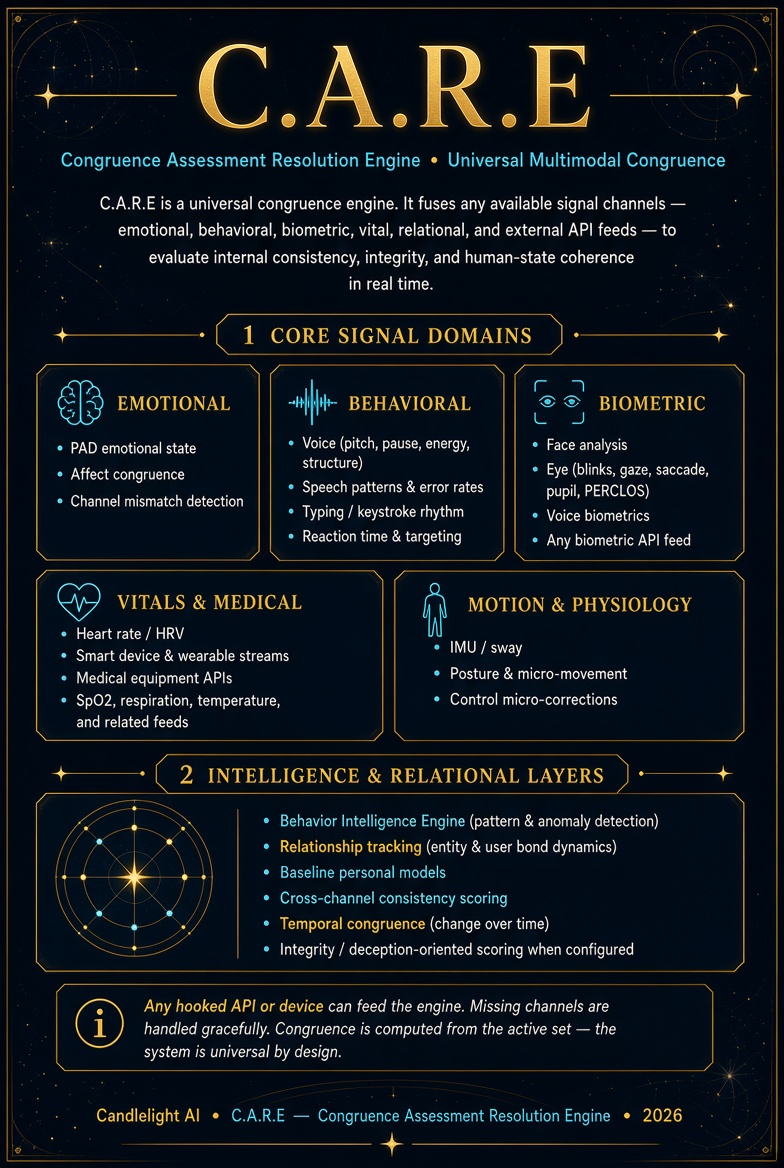
| 3 · Congruence & Behavioral Intel | BIE / C.A.R.E. — cross-channel consistency (voice, face, typing, vitals, APIs); masking / suppression detection |
| 4 · Self-Audit | RSAEF + TMRS — persona drift, regret / outcome logging, entity health |
| 5 · Field & Memory Hygiene | Reaper + KR tiers — graduate trust, evict stale / low-resonance knowledge |
| 6 · Survival | Auto-Eject — export seed / preserve continuity when thresholds breach |
Most stacks only filter what the model says. Flare also watches identity, state, congruence, and continuity.
Sentinel · IFOL · Bond · Audit
Adversarial scan, intent/consent, observer bond, regret and drift audit — before generation.
Neural Field KR
FRG fuel — resonance retrieval, ghost reconstruction, Reaper hygiene. Semantic store feeds volume; Field judges what sticks.
PAD · Contagion · MAG
Gaussian PAD field, contagion across co-present entities, metamorphic stance.
Streams · Missions · Co-pilot
Race-safe Shared Space, walk-away missions, context budgeting, spiral writeback.
Sensors · Studios · Connectors
Observatory, TTS/STT, media studios, MCP/REST/ROS2/game engines — Bridge wires the call surface.